
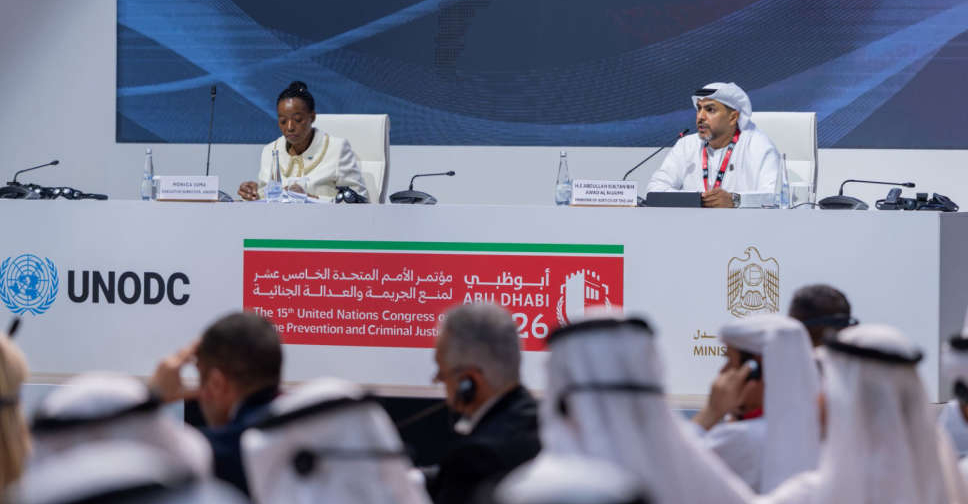
UAE Minister of Justice Abdullah Sultan bin Awad Al Nuaimi has emphasised the UAE's progressing integrated system for international judicial cooperation, noting that "borders should never become a shield for criminals".
During a meeting at the 15th United Nations Congress on Crime Prevention and Criminal Justice in Abu Dhabi, Al Nuaimi, who is also the Chairman of the Federal Judicial Council, said the system combines robust legal frameworks, direct partnerships, rapid response, and digital transformation.
"Crime today has no borders. Criminals, assets, money and evidence can move across several jurisdictions, which means that no country can fight transnational crime in isolation," said the UAE minister.
"We see international judicial cooperation as a partnership between countries, built on trust, direct communication, swift action and practical solutions," he added.
The minister outlined the legal framework supporting the UAE’s international judicial cooperation, which focuses on three main pillars, including multilateral agreements, bilateral agreements and domestic laws.
He noted that the UAE is a party to 16 universal and regional multilateral agreements and has more than 140 bilateral agreements in force with 53 countries covering extradition, mutual legal assistance, asset freezing and confiscation, evidence gathering, and the transfer of sentenced persons.
Around 30 per cent of the UAE's bilateral agreements were signed in the last five years, with four more to be signed before the end of this year, two under negotiation, and eight other agreements in draft form, he added.
Between 2021 and 2025, mutual legal assistance requests received increased by 244 per cent, while extradition requests rose by 235 per cent, said Al Nuaimi.
In 2025, the UAE received a total of 576 extradition requests. Courts issued decisions in 178 cases, while the remaining requests were either under review or awaiting additional information.
He also revealed that the average response time for voluntary extradition had been reduced to five days, while a complete mutual legal assistance request is executed within an average of 35 days, compared with the 60-to-180-day timeframe set out in the International Judicial Cooperation Guidelines.
Digital transformation reduced the processing time for certain procedures from seven days to just five minutes through the International Cooperation Assistance System (ICAS), he added.
The minister noted that moving forward, the UAE’s approach includes focusing on faster and more effective international cooperation and building strong and long-term international judicial partnerships.

 H.H. Sheikh Hamdan approves strategy for Dubai Longevity Authority
 Saif bin Zayed meets justice, interior ministers on crime congress sidelines
 Sheikh Abdullah holds bilateral talks with global counterparts at UN
 Three UAE aid convoys enter Gaza carrying 458 tonnes of supplies
 H.H. Sheikh Sultan earns Exeter PhD in Management